Seaggle Academy
Learn the technologies the industry is hiring for.
Structured pathways, single-topic intensives, and personalised tracks across AI, software, data, and cloud — taught by engineers who build these systems for a living.
A department, not a university — courses and personalised tuition in the technical skills industry is hiring for. Study a full pathway, or bring us the one technology you need to learn properly.
Who it is for
Four people the Academy is built around
Every pathway states its prerequisite. If you do not meet it, we will tell you rather than enrol you into something that will not work.
Early-career professionals
You have foundations and need practical depth plus evidence you can show.
Working professionals upgrading a skill
You are employed and adding a specific capability alongside your job.
Career switchers who meet prerequisites
You are moving from an adjacent technical role and can already write code.
Candidates preparing for interviews
You are actively applying and need preparation matched to real opportunities.
Learning pathways
Pathways described by what you will be able to do
Not a course catalogue — each pathway is defined by its outcome, the project you build, and the prerequisite to enter.

Taught sessions, guided practice, and a project you build and can defend
AI & Automation
Design and build a governed AI-enabled workflow or assistant.
- Representative project
- Permission-aware knowledge or operations assistant
- Prerequisite
- Programming or data fundamentals, depending on the level you enter at
Software Engineering
Build and explain a maintainable application or service.
- Representative project
- Full-stack product or operations platform
- Prerequisite
- Basic programming for intermediate tracks
Data & Analytics
Turn raw data into a reliable analytical product.
- Representative project
- Pipeline, model, dashboard, and insight narrative
- Prerequisite
- Spreadsheet and SQL familiarity, or programming, depending on level
Cloud & DevOps
Deploy, observe, and operate a modern workload.
- Representative project
- CI/CD deployment with monitoring and runbook
- Prerequisite
- Systems and networking fundamentals, depending on level
Technical Interview Preparation
Explain your experience, solve role-relevant problems, and respond under interview conditions.
- Representative project
- Interview portfolio: stories, explanations, mocks, improvement plan
- Prerequisite
- A target role and a current résumé
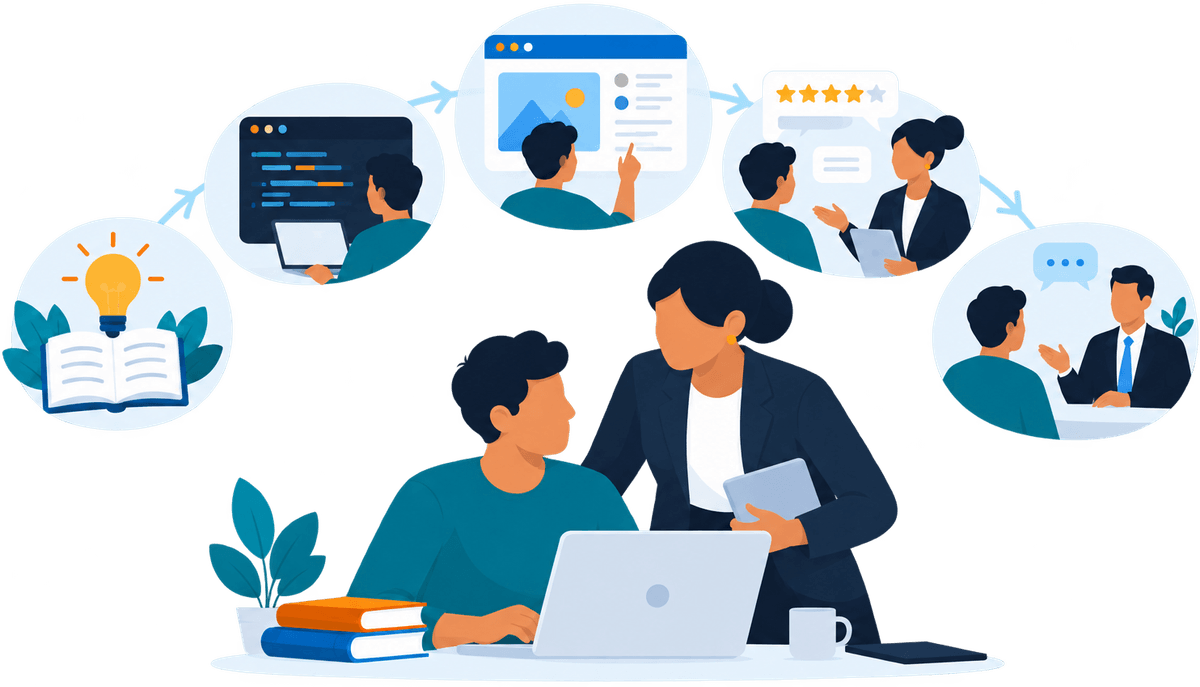
How learning works
Five stages, each producing something you keep
The difference from passive content is the middle three stages: you build, you get reviewed, and you revise.
Concepts
The ideas you need, taught in the order the work actually requires them.
You produce: Worked examples and reference material
Guided practice
Exercises with support available while you are still forming the habit.
You produce: Practice repository with feedback
Realistic project
A brief modelled on real work, with the ambiguity left in.
You produce: A project you built and can defend
Feedback
Review of your work the way production code is reviewed — specific and actionable.
You produce: Written review and revision cycle
Interview and career application
Turning what you built into something you can explain to a hiring panel.
You produce: Project narrative and prepared explanations
Project-based evidence
What you may build
Interviews go better when you can point at something specific. These are the kinds of projects the pathways produce.
Representative project
AI workflow prototype
A permission-aware assistant that cites sources and escalates uncertainty
- Retrieval
- Permissions
- Evaluation
- Human checkpoints
You finish with: Working prototype, evaluation set, and written design rationale
Representative project
Production-style web application
A deployed application with authentication, tests, and observability
- Architecture
- APIs
- Testing
- Deployment
You finish with: Repository, deployment, and architecture explanation
Representative project
Analytics pipeline and dashboard
Source data through to a dashboard with documented definitions
- Ingestion
- Modelling
- Quality testing
- Presentation
You finish with: Pipeline, tested models, dashboard, and insight narrative
Representative project
Cloud deployment and runbook
An observable workload with automated deployment and rollback
- Infrastructure as code
- CI/CD
- Monitoring
- Incident response
You finish with: Infrastructure repository, pipeline, and operational runbook
Representative example
Mentorship & feedback
Support from people who do the work
Mentors are working engineers. We publish named mentor profiles only once the individual and their involvement are confirmed — so what you see here is the model rather than a marketing roster.

Live guidance
Scheduled sessions where you can ask the question you would not ask in a group.
Code and project feedback
Your work reviewed specifically, with the reasoning behind each comment.
Practice review
Mock exercises reviewed for reasoning, not only for the answer.
Accountability
A regular checkpoint so progress does not quietly stall.
Role-aligned explanation coaching
Practice explaining your work in the vocabulary of the roles you are targeting.
Curriculum direction
We teach what the industry is actually asking for
The syllabus tracks live demand rather than last year's job postings. Each area below lists what teams are hiring for and what we therefore teach.
AI & applied automation
Teams want engineers who can evaluate a model's output, not only call an API — retrieval design, evaluation sets, guardrails, and cost control.
- Retrieval and grounding
- Evaluation harnesses
- Guardrails and human review
- Cost and latency
Software engineering
Demand keeps shifting toward people who can own a service end to end: design it, test it, ship it, and operate it.
- System design
- Testing strategy
- APIs and integration
- Release and observability
Data engineering
Pipelines that survive schema change, modelling that a business can read, and quality checks that fail loudly.
- Pipeline design
- Dimensional modelling
- Data quality
- Warehouse performance
Cloud & DevOps
Infrastructure as code, CI/CD that people trust, and enough operational literacy to be on call without fear.
- Infrastructure as code
- CI/CD
- Observability
- Incident practice
Ways to study
A full pathway, or just the one thing you need
Not everyone wants a programme. If you need one technology, one skill, or one gap closed, we teach that on its own.
Structured pathway
Cohort or self-pacedYou want a complete route through a discipline
A sequenced programme with concepts, guided practice, a build project, and written review at each checkpoint.
Personalised track
One to oneYou already know what gap you need to close
We assess where you actually are, then assemble a syllabus around the specific technology or skill you name — not a fixed curriculum you have to fit around.
Single-topic intensive
Short formatOne technology, learned properly
A short, focused block on one subject — a language, a framework, a platform, a technique — with a project that proves you can use it.
Team enablement
Private groupA group that needs the same capability
The same teaching delivered to an existing team, shaped around the systems they actually work on.
Personalised tracks
Tell us what you want to learn, and we build the syllabus around you
A personalised track starts from what you already know and what you are aiming at — not from a fixed catalogue you have to fit yourself into.
- 01
Tell us what you want to learn
A technology, a role you are moving toward, or a gap you keep hitting. Vague is fine at this stage.
- 02
Skills assessment
A short practical review of where you are now, so you are not taught what you already know or dropped into something you are not ready for.
- 03
A syllabus written for you
Scope, sequence, the project you will build, time commitment, and what you should be able to demonstrate at the end.
- 04
Teach, build, review
Sessions with a working engineer, practice between them, and written feedback on what you produce.
Transparent expectations
What we confirm before you commit
You should know all of this before sharing your information, let alone paying. Each item is confirmed for the specific program you are considering.
- Prerequisites and whether you meet them
- Duration and weekly time commitment
- Schedule and learning format
- The project you will build
- Price, payment terms, and what is included
- Cancellation and refund conditions
- Certificate status
- What the program does not promise
What Seaggle Academy is
Academy is not a university, a college, or an accredited institution, and it does not award degrees. It is a department inside Seaggle that teaches relevant technical skills — the ones industry is currently hiring for — through courses, single-topic intensives, and personalised tuition.
We teach technology. Completing a programme is not a route into employment, and studying with us confers no advantage in any hiring process — including Seaggle's own. Completing or purchasing an Academy program does not guarantee employment, an interview, a placement, an employer introduction, a salary, or a timeline.
Questions
Suitability, format, and boundaries
How do I know which pathway is right for me?
Each pathway states who it suits and who it does not, plus the prerequisite. If you are between two, speak to an advisor — a short conversation about your current level and target role settles it faster than a comparison table.
Do I need a computer science degree?
No. You do need the stated prerequisite for the pathway, which is usually working programming or data ability. The programs build on fundamentals rather than teaching them from zero.
What if I do not meet the prerequisite?
We will say so rather than enrol you into something that will not work. Where a foundations step is needed first, we will tell you what it is.
Is the learning live, recorded, or a mix?
Format, schedule, and time commitment are confirmed per program before you enrol. We publish those details once a cohort is confirmed rather than advertising a format we might change.
What happens if I miss a session?
The missed-session policy is set out in the program terms you receive before enrolling, so you know the answer before you commit rather than after.
What kind of feedback do I get on my project?
Your work is reviewed the way production code is reviewed: specific comments with the reasoning behind them, and a revision cycle so the feedback actually changes the work.
Seaggle Academy brochure
Seaggle Academy
The role-first preparation system: how a syllabus is built around your target role, the five stages and what each one produces, the role families, the project evidence you leave with, and how interview preparation works against a live job description.
Sent as a PDF to your email — we'll ask for your consent first.
Choose a path that matches your level and your next goal.
If you are between two pathways, a short conversation with an advisor settles it faster than a comparison table.